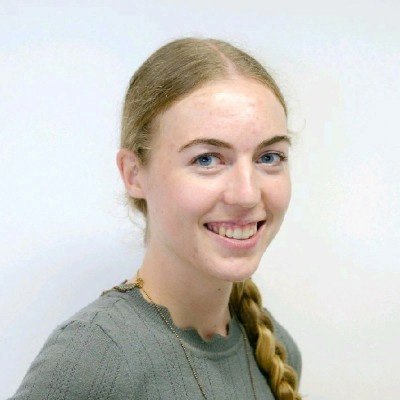
The KNCV-Van Arkel prize over calendar years 2024 and 2025 is awarded to Dr. Iris Smokers. She wrote her PhD thesis “Coacervate protocells as reaction centres at the origin of life” in the group of Dr. Evan Spruijt at Radboud University (Nijmegen). Competition for the prize was great, all candidates having done groundbreaking research, on quite different subjects, leading to several well-cited publications in reputed academic journals. The thesis by Smokers excels thanks to its inspiring overall narrative and discussions.
Smokers studied how the local physical environment inside coacervates affects the chemical reaction kinetics of molecules expected to have been present around the time when life on earth began. Coacervates are water-based droplets formed via liquid-liquid phase separation. Inside such droplets, the enhanced concentration of certain solutes and the local microenvironment (pH, polarity, charge density, viscosity…) have clear effects on reactivity, catalyzing certain reactions in a way expected to predate the existence of enzymes. As explained in the final discussion of the thesis (Chapter 9), precisely which molecules were present at the origin of life is a matter of speculation, but nevertheless, it is possible to elucidate “the general chemical and physical rules underlying the organization of molecules and reactions into complex out-of-equilibrium systems”.
Smokers demonstrated that a wide range of small anionic molecules that may have been present in the primordial soup can form coacervates. She showed that this can accelerate the oxidation of NADH (Chapter 6), promote the phosphorylation of ATP-analogues that do not react in dilute solution (Chapter 7), and affect the equilibrium of DNA and RNA duplex formation in a way that depends on hydrophobicity inside the droplets (Chapter 8). To draw these conclusions, she applied various methodologies, including numerical modeling of different types of reaction (bimolecular, polymerization, self-replication; Chapter 3), developing a new experimental approach to characterize the coacervate volume fraction (necessary to calculate concentrations of solutes; Chapter 4), and she developed a new NMR spectroscopy approach to characterize the uptake of specific ions, affecting the supramolecular interactions, local viscosity, and interfacial potential (Chapter 5).
The Royal Netherlands Chemical Society (KNCV) congratulates Dr. Iris Smokers with her scientific results and the Van Arkel prize.